- The Education Catalyst
- Posts
- 3 Mistakes We Make with Accommodations
3 Mistakes We Make with Accommodations

Lyndsay LaBrier
June 18, 2025
Why This Matters
Accommodations are meant to level the playing field—but all too often, they end up creating extra work with little effect. If you’ve ever wondered why your accommodations aren’t translating into real student success, you’re not alone.
Main Insight: The 3 Most Common Accommodation Mistakes
Accommodations should support a student’s access to learning, but three common mistakes often undermine their effectiveness:
1. Overgeneralizing Accommodations
Mistake: Applying the same accommodation to every subject or task (e.g., always allowing extra time, even when it’s unnecessary).
Consequence: Students rely on the accommodation rather than developing skills—creating dependency instead of independence (Williams & Carter, 2022).
2. Ignoring Student Input
Mistake: Selecting accommodations without consulting the student or observing their actual needs in context (e.g., providing text-to-speech software when the student struggles more with writing, not reading).
Consequence: Students feel unheard and may reject accommodations that don’t address their primary challenges (Davis, 2021).
3. Failing to Monitor Effectiveness
Mistake: Implementing an accommodation and forgetting to revisit its impact (e.g., adding a note-taker but never checking if notes are helpful or utilized).
Consequence: Accommodations remain in place long after they stop serving their purpose, leading to wasted resources and missed opportunities for adjustment (National Center for Education Statistics [NCES], 2023).
Addressing these mistakes begins with data, collaboration, and intentional design. Instead of a one-size-fits-all approach, consider each student’s unique profile, involve them in the discussion, and set benchmarks for evaluating whether the accommodation yields measurable benefits.
Facts & Statistics
Nearly 50% of educators report that accommodations are rarely adjusted once implemented, even when student needs shift—resulting in stagnant IEP progress (NCES, 2023).
Practical Tip
This week, review the accommodations on three randomly selected IEPs. For each:
Verify whether the student participated in selecting the accommodation.
Identify one measurable outcome you can track (e.g., reading comprehension, math fluency, writing accuracy).
Schedule a brief check-in with the student and the service provider in two weeks to see if the accommodation is making a difference.
Real World Solution
A 7th-grade student with a Specific Learning Disability in written expression, had “extended time” listed as a blanket accommodation across all subjects. Despite this, he was still turning in incomplete assignments and avoiding written tasks.
After a targeted review of his IEP and input from both the student and his intervention specialist, the team made adjustments. In language arts, instead of just extended time, he was given access to a digital graphic organizer and sentence stems for each writing task. In science, where writing demands were less complex, the teacher provided scaffolded prompts and allowed the student to verbally explain concepts before writing.
These changes reflected the student’s specific area of need—written expression—and honored his input. Within four weeks, his assignment completion rate increased by 40%, and his written responses became more detailed and organized. This example shows how individualized accommodations—rooted in a student’s IEP and specific skill deficits—are far more effective than generic supports applied across the board.
Call to Action
As you prepare for the upcoming school year, take a moment to reflect on how accommodations have been selected and adjusted in your setting. Ask yourself:
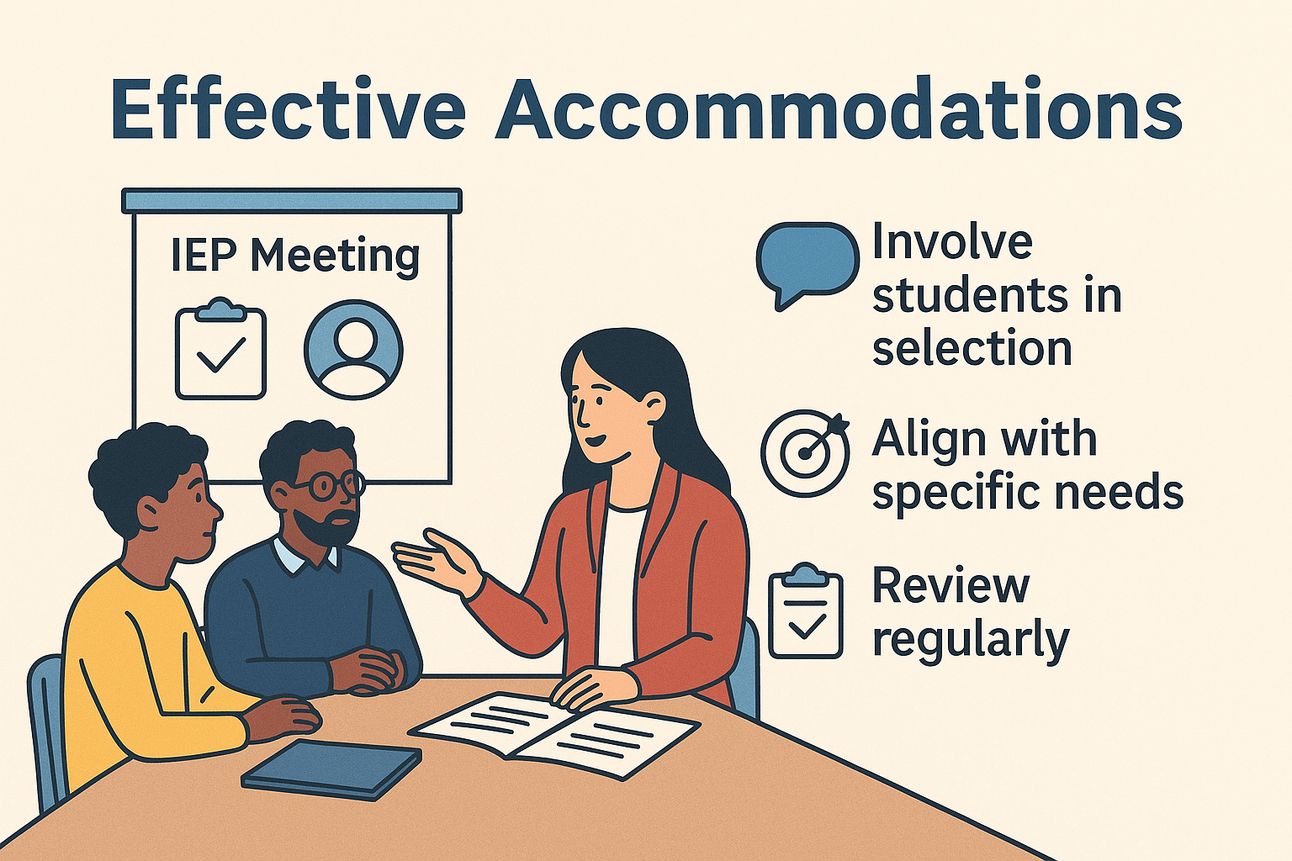
Are students meaningfully involved in choosing their accommodations?
Do the supports align with specific learning or behavioral needs?
Is there a process in place to review the effectiveness of accommodations regularly?
Whether you’re reviewing past plans or planning for fall, use this time to strengthen your approach to accommodations—so they lead to real, measurable growth, not just compliance.
P.S.
Which accommodation has had the biggest impact—or the least—on your students? Hit reply and share your experience.
References
Davis, R. (2021). Student voice in accommodation selection: A qualitative study. Journal of Special Education Collaboration, 13(2), 77–85.
Gonzalez, M., Patel, S., & Lee, J. (2023). Subject-specific accommodations and student outcomes in middle school. Learning Disabilities Quarterly, 47(1), 12–25.
National Center for Education Statistics. (2023). Nationwide report on IEP practices. https://nces.ed.gov
Williams, T., & Carter, L. (2022). Overgeneralization of accommodations and student dependency. Journal of Education Research, 14(4), 102–110.
Reply