- The Education Catalyst
- Posts
- The Education Catalyst

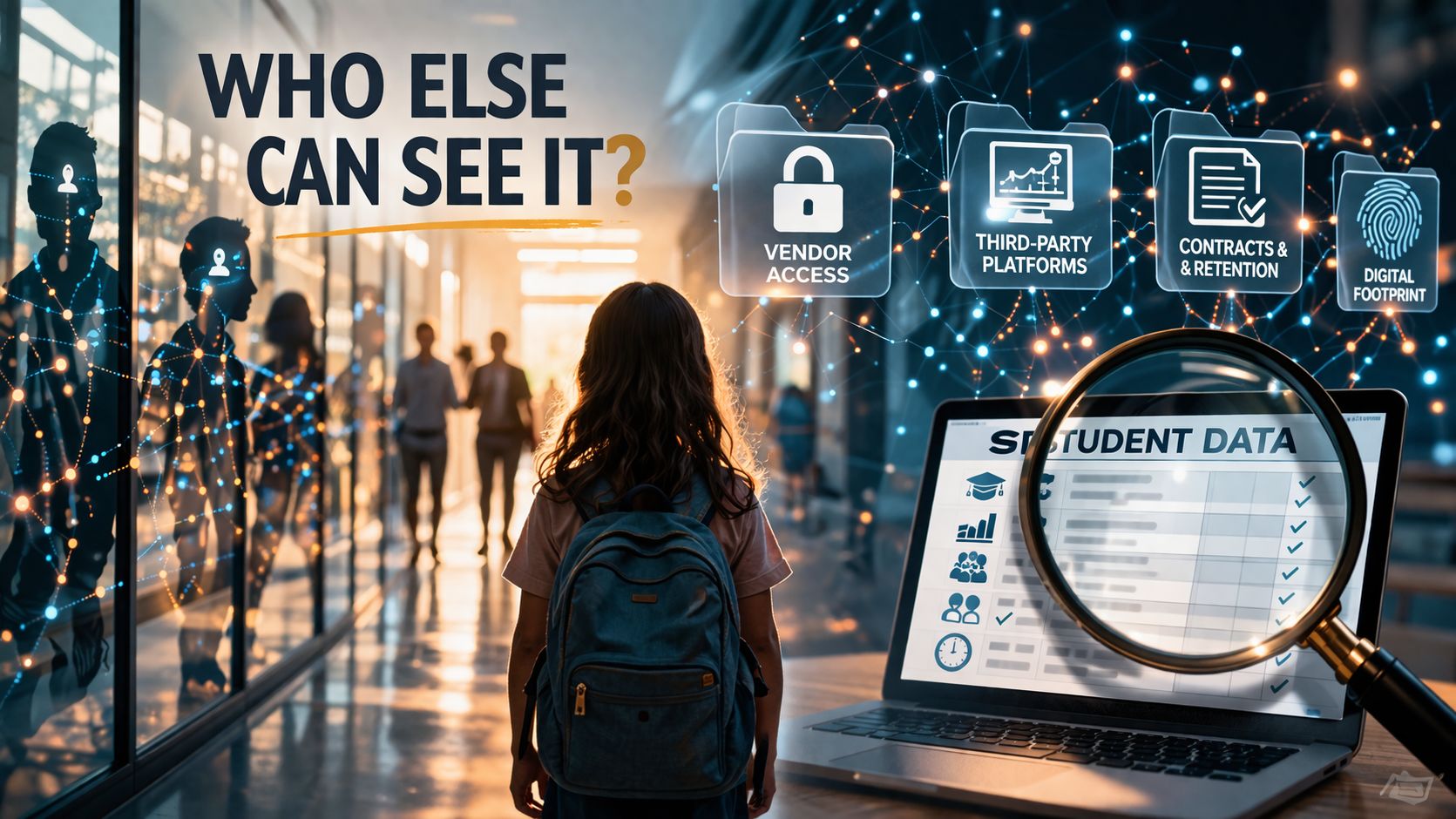
The Invisible Audience Watching Our Students
We Think It Stays in the School System… It Doesn’t
We’ve been told—over and over—that student data is collected to help.
To personalize learning.
To identify needs.
To close gaps.
And on the surface, that sounds right.
But here’s the question no one is asking loudly enough:
Who else can see it?
Because once student information enters a digital system, it rarely stays contained within a single classroom… or even a single district.
It moves.
Through platforms.
Through vendors.
Through contracts most people never read.
And the reality is—there is an invisible audience watching data that was never meant for them.
The System Behind the Screen
When teachers input grades, behaviors, accommodations, or intervention data, it often flows into third-party systems—platforms created and maintained by private companies.
These companies provide:
Learning management systems
Behavior tracking tools
Assessment platforms
Progress monitoring dashboards
But here’s what matters:
They don’t just store data—they often process, analyze, and retain it.
Under laws like Family Educational Rights and Privacy Act, schools are allowed to share student data with vendors classified as “school officials” if they perform institutional services.
That means:
Third-party access isn’t a loophole. It’s built into the system.
Vendor Access: The Part No One Explains
Let’s simplify it.
If a school uses a platform, the company behind that platform may have access to:
Student performance trends
Demographic data
Behavioral patterns
Intervention histories
Even when personally identifiable information is removed, data patterns remain highly valuable.
Research shows that de-identified data can often be re-identified or still used to draw conclusions about specific populations (Ohm, 2010).
And those patterns can be used to:
Predict outcomes
Identify “high-risk” groups
Inform product development or market strategies
Now ask yourself:
Should private companies have long-term insight into how entire communities of students perform?
Real-World Example: When Data Leaves the Building
Imagine this:
A district inputs years of student data—academic struggles, attendance, behavior—into a digital platform.
That platform aggregates data across districts.
Now zoom out.
According to U.S. Government Accountability Office, many school districts rely on multiple online services that collect, store, and sometimes share student information, often with limited visibility into how that data is used beyond the original purpose (GAO, 2016).
This creates the potential for:
Cross-district data insights
Long-term storage outside district control
Secondary uses that families are unaware of
So while families believe data is being used to support their child…
it may also contribute to broader analyses far beyond the classroom.
Contracts, Retention, and the Digital Footprint
Here’s where it gets more concerning:
Vendor contracts often define:
Data ownership
Retention timelines
Permitted uses of data
But these contracts are rarely accessible—or understandable—to families.
According to Future of Privacy Forum guidance, key risks include:
Data retained longer than necessary
Vague language around data use
Limited parent awareness or consent mechanisms
This creates a persistent digital footprint for students.
And unlike a classroom mistake…
digital records don’t simply disappear.
Why This Matters More Than We Think
This isn’t about fear—it’s about systems.
Because:
Student data informs school decisions
School data influences funding and policy
Policy shapes community opportunity
The National Center for Education Statistics emphasizes that education data is used to guide decision-making at multiple levels—local, state, and national.
But when that same data is accessible beyond those intended levels…
the impact expands beyond education.
The Hard Truth
We’ve been told transparency protects students.
But here’s the reality:
Transparency without boundaries can expose them.
There is a difference between:
Data used by educators to support students
andData systems that extend access beyond the classroom
One is care.
The other can become uncontrolled distribution.
What We Should Be Asking Instead
Not “Is data being used?”
But:
Who has access to it—really?
How long is it stored?
Can it be deleted?
Who benefits beyond the school?
Do families truly understand what they’ve agreed to?
Because if we don’t ask these questions…
they get answered in contracts—not conversations.
Call to Action: Protect the Data, Protect the Student
If we truly want to protect students, then we need to:
Demand clear, transparent vendor agreements
Limit unnecessary data collection
Establish strict data retention policies
Ensure parent access and understanding
Prioritize student protection over platform convenience
Because once data leaves the classroom…
we lose control of the story it tells.
Closing Reflection
This may seem small—just data, just systems.
But small decisions, repeated, create infrastructure.
And infrastructure shapes outcomes.
So when we allow student data to move freely without understanding where it goes…
we’re not just documenting learning.
We’re shaping futures—sometimes without realizing it.
Lyndsay LaBrier
Merchant Ship Collective
The Education Catalyst
References
Electronic Frontier Foundation. (2021). Student privacy and data protection. https://www.eff.org
Ohm, P. (2010). Broken promises of privacy: Responding to the surprising failure of anonymization. UCLA Law Review, 57(6), 1701–1777.
U.S. Government Accountability Office. (2016). Student data privacy: School districts’ use of online educational services (GAO-16-679). https://www.gao.gov
U.S. Department of Education. (2020). Protecting student privacy while using online educational services. https://studentprivacy.ed.gov
Future of Privacy Forum. (2022). Student privacy resources. https://fpf.org
National Center for Education Statistics. (2023). The condition of education. https://nces.ed.gov
Reply