- The Education Catalyst
- Posts
- The Education Catalyst

Why Missouri’s AMI system is missing the point
The magic wasn’t the snow. It was the permission.
A real snow day feels like a small miracle.
The house is quieter. The clock loosens its grip. Backpacks stay where they were dropped the night before. The world outside is hushed in white, and for once, nothing is expected immediately.
Snow days have never been about avoiding school.
They’ve been about being human.
For children, they are wonder—windows fogged with breath, the thrill of an unexpected gift of time.
For families, they are rare alignment—no rushing, no dividing, no apologizing for choosing rest.
For educators, they are one of the only moments when the pace of the system is forced to slow without guilt.
A snow day quietly tells everyone the same thing:
You are allowed to stop.
And that permission is powerful.
Not because learning doesn’t matter—but because nervous systems do. Because safety does. Because joy, unstructured time, and shared memory are not distractions from childhood. They are part of it.
Snow days became legendary not just because of sleds or cocoa, but because entire neighborhoods paused together. One announcement. One collective exhale. One day where productivity was not the measure of worth.
That kind of pause is increasingly rare in modern life.
A small ritual in a loud world
Snow days were never written into lesson plans.
They were stitched into memory.
They live in the sound of a radio announcement, the vibration of a phone alert, the sudden realization that today will unfold differently than yesterday promised. They are the stories adults still tell decades later: “Do you remember the blizzard when…”
In a world that rarely stops demanding output, snow days have quietly stood as proof that not every interruption is a failure.
Some interruptions are protective.
Some are necessary.
Some are sacred.
And yet, slowly, these pauses are being redesigned into something else entirely—converted into logins, assignments, attendance codes, and digital compliance.
What was once a day of safety and shared relief is increasingly treated as a logistical inconvenience that must be optimized.
That shift matters.
Because when a system can no longer tolerate stillness, it begins to confuse motion with meaning.
How snow days became a tradition
Snow days, as we recognize them today, did not always exist.
They emerged as public schooling became centralized, transportation systems expanded, and communities began coordinating around shared schedules. As radios and television entered homes, school closures turned into a collective ritual—families gathered around announcements, children holding their breath, entire neighborhoods learning the news at once (The Atlantic, 2023).
What began as a safety decision became something cultural.
A shared pause.
A story passed down.
In the last decade, however, many states and districts have moved to replace these closures with remote instruction, reframing the day not as a break, but as school relocated to the kitchen table (Berger, 2018; Governing, 2023).
The question is no longer whether learning should continue.
It is whether safety, equity, and human limits still matter when policy is written.
What the data actually shows
Snow days are not the greatest threat to learning time.
A large study in Massachusetts found that student absences account for far more lost instructional time than school closures. Weather-related closures made up less than one quarter of missed school days overall (Goodman, 2014).
In other words, the system often fixates on the visible disruption—a closed building—while overlooking the daily, quieter disruptions of illness, instability, transportation barriers, and chronic stress.
Short closures are also just that: short.
An analysis of California schools found that most closures lasted only one to two days for affected schools (Gorham et al., 2022).
Remote instruction is not an equal substitute.
Multiple studies and national reporting show that remote learning often results in lower engagement and reduced academic progress, particularly when technology access, home supervision, or learning needs vary (Betthäuser et al., 2023; EducationNext, 2024; Associated Press, 2024).
And access still isn’t equal.
Households with lower incomes remain significantly less likely to have reliable broadband service, making any assumption of universal participation unrealistic (Pew Research Center, 2024, 2025).
When we treat every emergency day as a digital school day, we quietly transfer the burden onto families who already carry the most.
A real snow day, remembered
One of the best snow days I remember had nothing to do with curriculum or productivity.
It was the sound of a household finally slowing down.
No alarms.
No arguments over missing shoes.
No rush to beat traffic or bells.
Kids built elaborate, impractical inventions from whatever they could find.
Adults became present in the way we always promise ourselves we will be “when things calm down.”
Neighbors checked on neighbors.
There was no lesson objective.
And yet, something important was learned.
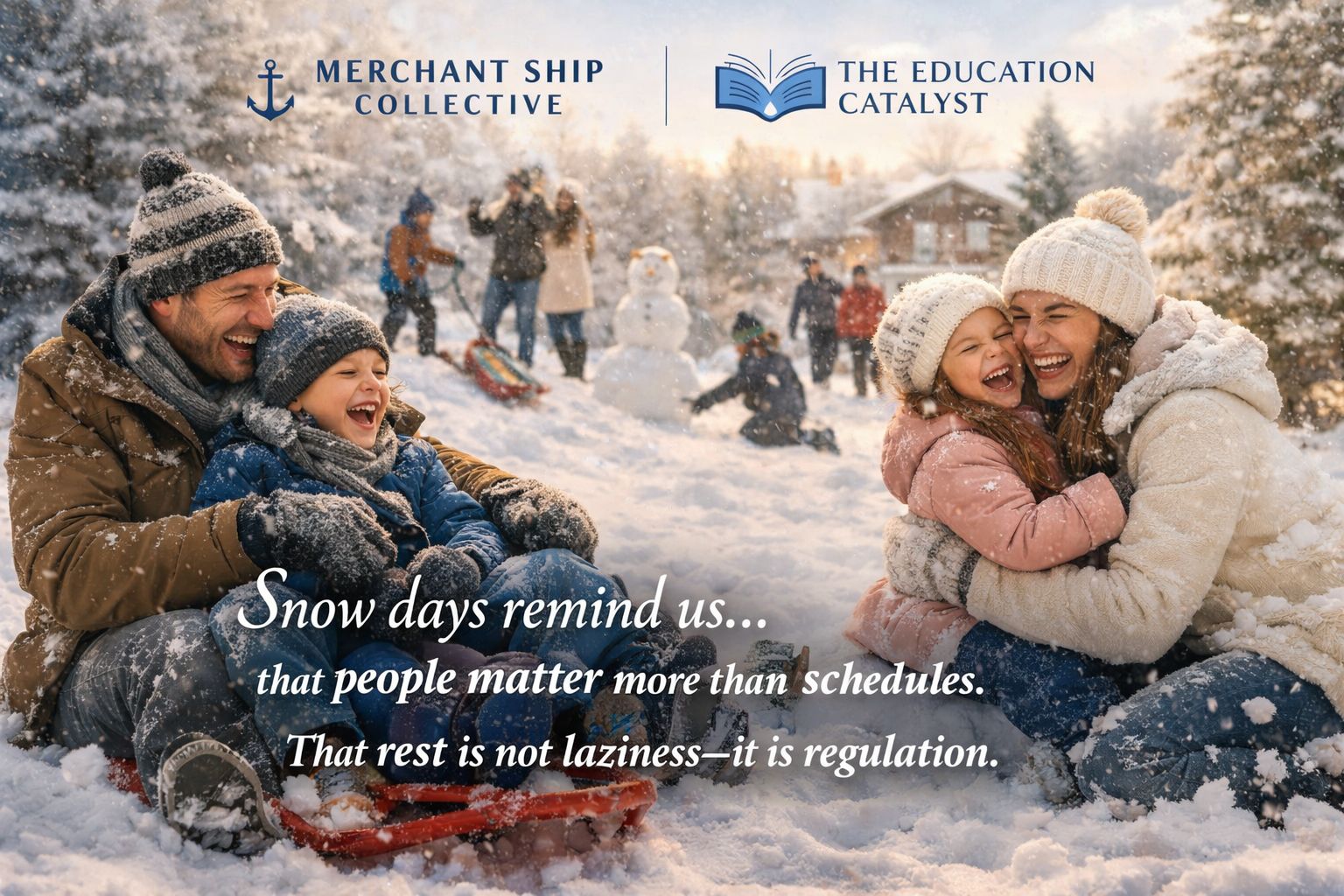
That people matter more than schedules.
That safety is not negotiable.
That rest is not laziness—it is regulation.
Missouri’s AMI reality
In Missouri, districts with an approved Alternative Methods of Instruction (AMI) plan are allowed to count up to 36 hours per school year as instructional time during emergency closures, including weather-related closures (Missouri Department of Elementary and Secondary Education [DESE], n.d.; RSMo § 171.033, n.d.).
In most districts, those 36 hours equal approximately five to six full school days, depending on the length of the school day.
After those hours are used, additional closure time generally must be made up in person, unless the state grants another waiver.
In practice, this means many districts automatically convert early snow days into AMI days to protect calendars and funding.
On paper, this sounds flexible.
In reality, it often becomes:
• a compliance tool to protect attendance accounting and funding formulas
• a stress multiplier for families during unsafe conditions
• an instructional compromise for young learners and students with disabilities
• an equity issue hidden behind technology language
Participation is usually tracked through assignment completion or online activity—an approach that assumes reliable power, internet access, devices, and adult support in every household.
And when platforms fail, power is out, or families are managing emergencies, the day becomes neither restful nor educational.
It becomes performative.
If the roads are unsafe, the day is unsafe.
Learning cannot be built on top of risk and called progress.
The real pressure
The tension does not come from educators or families.
It comes from policy.
Seat-time formulas.
Attendance accounting.
Testing schedules.
Funding tied to presence rather than reality.
These pressures quietly ask people to choose between safety and compliance.
Parents calculate risk.
Teachers brace for expectations.
Students absorb the message that showing up matters more than being okay.
That is not accountability.
It is misalignment.
A better approach
Missouri does not need to eliminate flexibility.
It needs to redirect it.
Instead of forcing learning to occur during unsafe conditions, the state should give districts more freedom to use real snow days—and acknowledge that AMI, as currently designed, does not accomplish what it claims to.
A reasonable path forward would include:
• A guaranteed statewide bank of true snow days (for example, five to seven days) that can be used without financial penalty or attendance consequences.
• Local discretion for districts to decide when conditions truly support learning and when safety and stability should come first.
• Phasing out AMI as a default response to weather closures, recognizing that it consistently fails to deliver equitable, high-quality instruction during emergencies.
• Accountability systems that stop equating physical presence or digital logins with learning.
• Recognition that healthy systems build buffers instead of blaming people for weather, illness, infrastructure failures, or family circumstances.
Flexibility should mean protecting people—not redesigning risk as rigor.
Call to Action
If you are an educator, parent, or community member in Missouri:
• Ask how AMI participation is measured and who it leaves behind.
• Advocate for protected safety closures without financial punishment.
• Push for accountability that reflects real learning conditions—not just calendar optics.
Closing Reflection
Snow days were never a flaw in the system.
They were one of the few moments the system admitted the truth—that children are not machines, families are not logistics, and learning cannot thrive where safety is treated as optional.
If education is meant to prepare students for the real world, then it should also model what the real world requires when conditions are dangerous: caution, care, and collective responsibility.
Progress does not come from pretending risk is rigor.
It comes from building systems that protect people first.
In solidarity,
Lyndsay LaBrier
The Merchant Ship Collective
References
Associated Press. (2024). New York City schools went online instead of calling a snow day. It didn’t go well. https://apnews.com/article/2ef89fedcd4caefc3d6b6c483188e888
Berger, T. (2018, November 19). The beginning of the end of snow days. Edutopia. https://www.edutopia.org/article/beginning-end-snow-days/
Betthäuser, B. A., Bach-Mortensen, A. M., & Engzell, P. (2023). A systematic review and meta-analysis of the evidence on learning during the COVID-19 pandemic. Nature Human Behaviour. https://www.nature.com/articles/s41562-022-01506-4
DESE. (n.d.). Alternative Methods of Instruction (AMI). Missouri Department of Elementary and Secondary Education. https://dese.mo.gov/alternative-methods-instruction-0
EducationNext. (2024, September 17). Zooming to class slows student learning. https://www.educationnext.org/zooming-to-class-slows-student-learning/
Goodman, J. (2014). Flaking out: Student absences and snow days as disruptions of instructional time (NBER Working Paper No. 20221). National Bureau of Economic Research. https://www.nber.org/system/files/working_papers/w20221/w20221.pdf
Gorham, T., et al. (2022). Impact of short school closures (1–5 days) on overall academic performance of schools in California. Scientific Reports. https://www.nature.com/articles/s41598-022-06050-9
Governing. (2023). Are snow days about to get buried by remote learning? https://www.governing.com/now/are-snow-days-about-to-get-buried-by-remote-learning
Pew Research Center. (2024, January 31). Americans’ use of mobile technology and home broadband. https://www.pewresearch.org/internet/2024/01/31/americans-use-of-mobile-technology-and-home-broadband/
Pew Research Center. (2025, November 20). Internet, broadband fact sheet. https://www.pewresearch.org/internet/fact-sheet/internet-broadband/
Revisor of Statutes, State of Missouri. (n.d.). RSMo § 171.033. https://revisor.mo.gov/main/OneSection.aspx?section=171.033
The Atlantic. (2023, January 4). How children conjure a snow day. https://www.theatlantic.com/family/archive/2023/01/where-snow-day-rituals-supersititions-come-from/672627/
Reply