- The Education Catalyst
- Posts
- The Education Catalyst
The Education Catalyst
Factory Lines to Corporate Cubicles: How School Became Training for Dysfunction

Lyndsay LaBrier
January 22, 2026
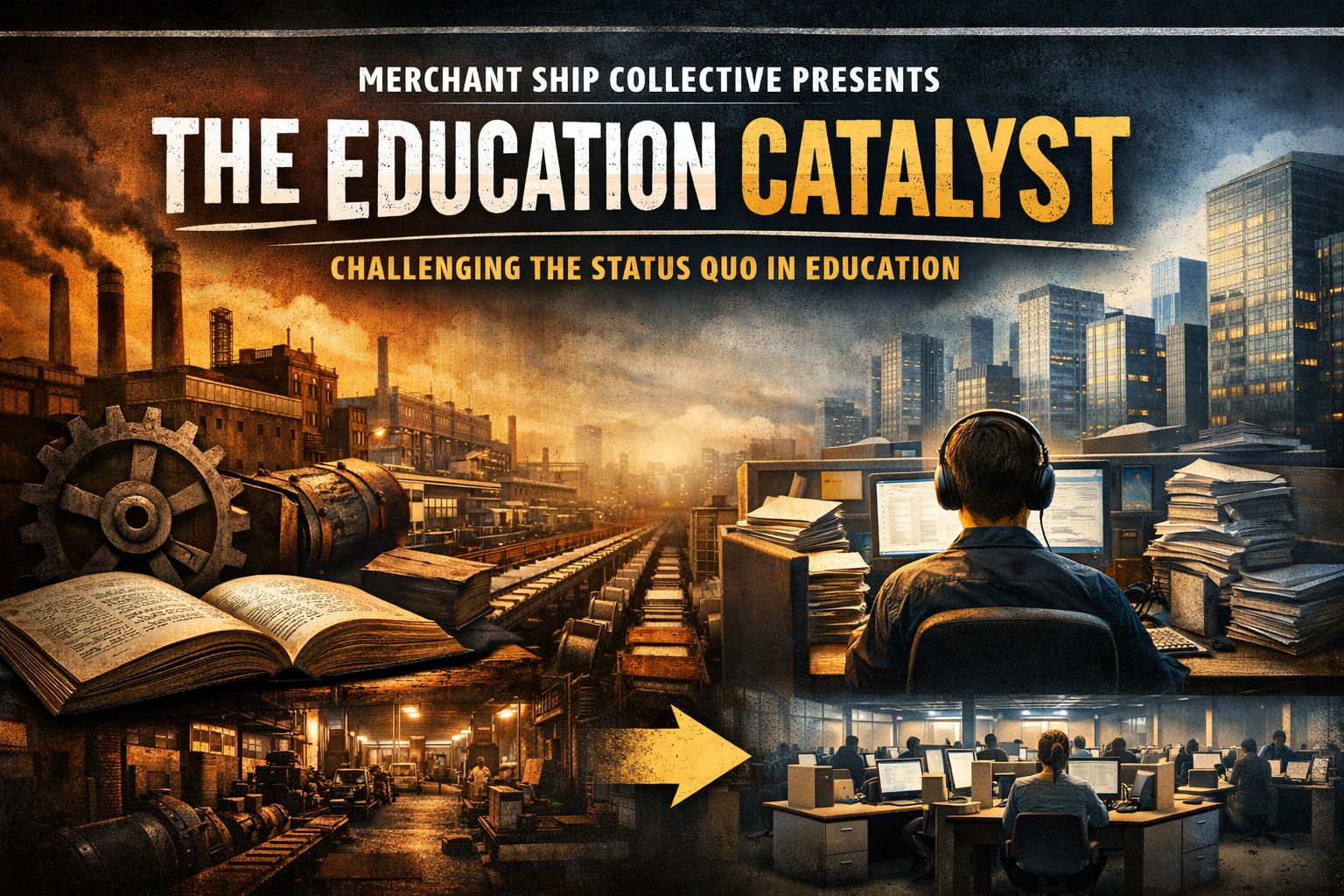
An examination of how public education evolved from industrial-era workforce preparation into a system that now unintentionally conditions students for toxic organizational cultures—while failing to equip them with real-world responsibility, accountability, and social competence.
The System Was Never Neutral
There’s a phrase educators hear often:
“Public education was designed to prepare students for factory work.”
That statement isn’t wrong.
But it’s far too gentle.
Public education was designed to condition human behavior for economic systems.
Factories were simply the first destination.
The deeper purpose was never craftsmanship. It was compliance. Predictability. Obedience to structure. Tolerance for monotony. Acceptance of hierarchy.
When factory labor was outsourced, the system did not reform.
It rebranded.
The architecture stayed intact:
Bells
Age-based sorting
Standardization
Surveillance
Reward compliance
Punish disruption
Only the endpoint changed.
Students are no longer being prepared to operate machines.
They are being prepared to survive institutions.
Bureaucracies. Corporations. Healthcare systems. Government agencies. Education itself.
Places where power is protected. Where responsibility is diluted. Where dysfunction is procedural.
Public education still prepares students for their future.
It just prepares them to endure systems that no longer serve them.
Facts & Statistics
Workplace toxicity & readiness
One in five employees report working in a toxic workplace environment (Huang et al., 2022).
76% of U.S. workers report experiencing burnout at least sometimes (Gallup, 2023).
Poor management, unclear expectations, and lack of accountability are among the strongest predictors of workplace stress and turnover (American Psychological Association [APA], 2023).
Skill gaps
Approximately 70% of employers report that recent graduates lack professionalism and workplace communication skills (National Association of Colleges and Employers [NACE], 2022).
Only 34% of employers believe graduates are adequately prepared for entry-level work (McKinsey & Company, 2023).
Behavior systems & accountability
Schools implementing PBIS often show short-term reductions in office discipline referrals, but mixed evidence for long-term improvements in self-regulation and internalized behavioral skills (Institute of Education Sciences, 2021).
Over-reliance on external rewards is associated with decreased intrinsic motivation over time (Deci & Ryan, 2000).
Youth workforce attitudes
58% of Gen Z workers report feeling over-qualified for their first job despite limited formal work experience (LinkedIn Economic Graph, 2023).
What This Looks Like in Real Life
A student graduates high school.
They are told they are “college and career ready.”
What they actually know:
How to negotiate consequences
How to perform remorse
How to exploit policy language
How to comply when observed
How to avoid ownership when convenient
What they do not know:
How to accept correction without collapse or rage
How to show up consistently when no one is watching
How to communicate under pressure without hostility
How to work through conflict instead of around it
How to take responsibility when it costs them something
They enter their first job.
They expect authority without apprenticeship. Respect without contribution. Flexibility without reliability.
They call boundaries “toxicity.” They call standards “oppression.” They call feedback “disrespect.”
And the workplace absorbs them effortlessly.
Because the workplace is already fluent in the same language.
Avoid responsibility. Document everything. Redirect blame. Protect the structure. Reward performance. Ignore substance.
The system recognizes its own conditioning.
The PBIS Problem No One Wants to Name
PBIS is marketed as compassion.
In practice, it functions as infrastructure.
A national behavior management industry disguised as student support.
PBIS did not spread because it transformed children.
It spread because it transformed schools into predictable, fundable, auditable systems.
It offers:
Compliance metrics
Implementation contracts
Software platforms
Professional development pipelines
Federal grant alignment
It teaches students a devastating lesson:
Outcomes are negotiable.
Say the right words. Complete the reflection sheet. Select the correct emotion from the list. Return to class.
No repair. No restitution. No ownership.
Behavior becomes paperwork.
And paperwork becomes absolution.
This is not character education.
It is liability management.
When Education Technology Becomes Extraction
Programs like i-Ready are not neutral tools.
They are revenue models with students embedded inside them.
Districts sign multi-year contracts. Students take repeated benchmark tests. Teachers adjust instruction to satisfy platform outputs.
Time is converted into data.
Data is converted into reports.
Reports justify renewals.
Renewals justify expansion.
Human development becomes a byproduct.
Curriculum Associates did not build a system optimized for children.
They built one optimized for scale, dependency, and recurring payment.
Schools now organize instruction around what software can measure.
Not what life demands.
Reading a dashboard is rewarded.
Navigating conflict is not.
Completing modules is tracked.
Developing judgment is not.
Students learn to perform for algorithms long before they perform for reality.
When Education Technology Becomes an Industry
Programs like i‑Ready are marketed as tools for personalized learning and academic growth.
They are also billion‑dollar products.
Curriculum Associates, the company behind i‑Ready, reported revenues exceeding $2 billion in recent years, driven primarily by large, multi‑year district contracts (Curriculum Associates, 2023).
These systems require:
Annual licensing fees
Ongoing assessments
Data reporting infrastructure
Professional development subscriptions
Which means districts are no longer just educating students.
They are maintaining technology ecosystems.
Instructional time becomes testing time.
Students become data points.
Teachers become implementers of proprietary systems.
And success becomes defined by:
Platform growth metrics
Usage statistics
Compliance reports
—not by long‑term human outcomes.
When profit depends on constant measurement, students are conditioned to perform for systems instead of developing mastery for life.
What We Abandoned Along the Way
We quietly walked away from:
Teaching social responsibility explicitly
Practicing accountability daily
Modeling professional conflict resolution
Expecting follow-through
Valuing contribution over performance
And we replaced it with:
Incentives
Loopholes
Optics
Buzzwords
Data dashboards
We didn’t dismantle the factory model.
We digitized it.
Call to Action
Stop pretending this is accidental.
Systems do what they are designed to do.
Our current system produces:
Compliance without conscience
Confidence without competence
Entitlement without contribution
Survival skills mislabeled as leadership
If we want different outcomes, we must design for them.
That means:
Replacing reward economies with responsibility frameworks
Teaching social norms explicitly instead of apologizing for them
Treating accountability as protection, not punishment
Measuring growth by follow-through, not behavior charts
Preparing students for adulthood, not institutional endurance
And it means confronting the truth educators are rarely allowed to say out loud:
We are not underfunded.
We are misaligned.
We are not broken.
We are operating exactly as designed.
In solidarity,
Lyndsay LaBrier
Merchant Ship Collective
References
American Psychological Association. (2023). Work and well-being survey report. https://www.apa.org
Curriculum Associates. (2023). Company overview and impact report. https://www.curriculumassociates.com
Deci, E. L., & Ryan, R. M. (2000). Intrinsic and extrinsic motivations: Classic definitions and new directions. Contemporary Educational Psychology, 25(1), 54–67. https://doi.org/10.1006/ceps.1999.1020
Gallup. (2023). State of the global workplace report. https://www.gallup.com
Huang, K., Li, Y., & Wu, Y. (2022). Toxic workplace environments and employee outcomes. MIT Sloan Management Review.
Institute of Education Sciences. (2021). What Works Clearinghouse: PBIS intervention report. U.S. Department of Education. https://ies.ed.gov
LinkedIn Economic Graph. (2023). Gen Z and early career workforce report. https://economicgraph.linkedin.com
McKinsey & Company. (2023). The state of skills and workforce readiness. https://www.mckinsey.com
National Association of Colleges and Employers. (2022). Job outlook survey. https://www.naceweb.org
U.S. Department of Education. (2022). Positive Behavioral Interventions and Supports technical assistance center overview. https://www.pbis.org
Reply