- The Education Catalyst
- Posts
- The Education Catalyst

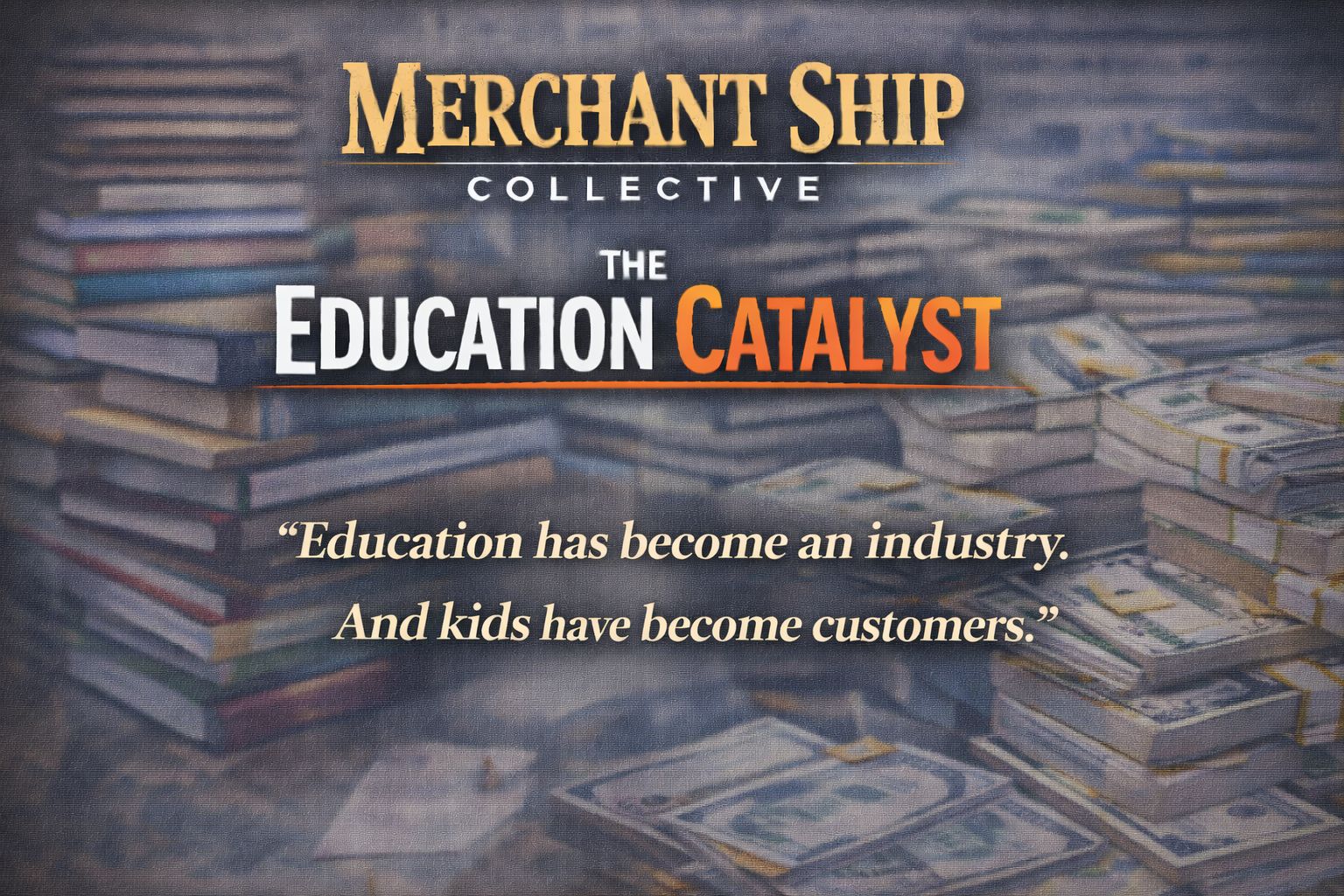
Issue 6: Profits, Corporate Influence, and Ed Tech Control
When Schools Became Markets and Students Became Customers
The Quiet Shift
Public education did not suddenly become an industry.
The shift happened gradually.
Over the last several decades, school systems began purchasing an expanding number of external services to solve educational challenges.
Curriculum packages.
Assessment platforms.
Behavior intervention systems.
Consultant-driven professional development.
Digital learning ecosystems.
At first, these tools were meant to support teachers.
But over time something else happened.
Solutions that once came from educators themselves increasingly began coming from vendors.
Instead of building internal expertise, districts began buying it.
And when solutions are purchased rather than developed, a system slowly becomes dependent on the marketplace that supplies them.
The Curriculum Economy
Curriculum used to be something teachers designed, adapted, and refined based on the needs of their students.
Today, many districts rely on large-scale curriculum adoption cycles that involve national publishing companies and multi-year contracts.
Major curriculum publishers now offer bundled systems that include:
• instructional materials
• online learning platforms
• assessment tools
• teacher training modules
• student data dashboards
These systems are marketed as “comprehensive solutions.”
But they often come with rigid pacing guides, scripted instruction, and implementation expectations that leave little room for teacher adaptation.
Research has shown that while high-quality instructional materials can support teaching, their effectiveness depends heavily on teacher autonomy and contextual adaptation (Kaufman et al., 2020).
When curriculum becomes a product rather than a tool, instruction risks becoming standardized rather than responsive.
Consultant Culture
Another growing feature of modern education is the consultant ecosystem.
School districts regularly hire consultants to help address challenges such as:
• instructional improvement
• leadership coaching
• equity initiatives
• strategic planning
• professional learning systems
• behavior frameworks
Consultants can bring valuable outside perspectives.
But consultant culture also introduces a structural tension.
When districts rely heavily on outside experts, internal expertise can become undervalued.
Teachers—who interact with students every day—may find themselves expected to implement strategies designed by people who do not work in their classrooms.
Research on organizational learning suggests that sustainable improvement depends on developing internal capacity rather than relying exclusively on external expertise (Fullan, 2016).
When solutions are repeatedly outsourced, long-term institutional knowledge can weaken.
The Program Purchasing Cycle
Perhaps the most visible sign of education’s transformation into an industry is the program purchasing cycle.
When schools face challenges such as:
• declining literacy rates
• behavioral disruptions
• absenteeism
• teacher turnover
Districts often respond by purchasing programs designed to address those issues.
Literacy programs.
Behavior management systems.
Social-emotional learning platforms.
Student engagement apps.
The intention is usually positive.
But over time, program purchasing can replace deeper structural intervention.
Instead of asking:
“What conditions are causing these problems?”
Systems begin asking:
“What program should we buy next?”
Education policy scholars have described this phenomenon as “reform churn,” where new initiatives are introduced before previous ones have been fully evaluated (Hess, 2017).
Teachers often experience this cycle as initiative fatigue—constantly adapting to new programs without seeing long-term stability.
When Solutions Become Products
The expansion of educational vendors has created a significant marketplace around public education.
Curriculum publishers, professional development companies, and EdTech firms collectively represent a multi-billion-dollar industry.
According to national education finance data, public elementary and secondary education spending in the United States exceeds $800 billion annually, creating a vast ecosystem of vendors and services connected to the school system (National Center for Education Statistics [NCES], 2023).
Within that ecosystem:
• companies design products to address educational challenges
• districts purchase those products to demonstrate action
• teachers implement them under tight timelines
• outcomes are evaluated within limited time frames
Sometimes these products help.
Sometimes they do not.
But the underlying system remains the same:
Education problems become opportunities for market solutions.
Facts & Statistics
Several national trends help illustrate the scale of education’s transformation into a marketplace.
• U.S. public elementary and secondary education spending reached approximately $857 billion in 2021–2022 (NCES, 2023).
• School districts increasingly rely on external vendors for digital platforms, curriculum materials, and professional development services.
• Research has found that teachers frequently experience “initiative overload” as schools implement multiple reform programs simultaneously (Kaufman et al., 2020).
• Policy research shows that sustained improvement depends more on leadership stability and internal professional capacity than on short-term program adoption (Fullan, 2016).
These findings suggest that while external tools can support education, they cannot replace strong internal systems.
Real-World Solutions
Strengthening Internal Expertise
Districts should prioritize developing teacher leadership and internal instructional expertise rather than relying exclusively on outside consultants.
Evaluating Programs Before Expanding Them
Programs should be piloted, evaluated, and adjusted before large-scale district implementation.
Reducing Initiative Overload
Schools benefit from stability. Limiting the number of simultaneous initiatives allows teachers to implement strategies more effectively.
Prioritizing Teacher Input
Teachers should play a central role in evaluating curriculum and programs, since they are responsible for implementation.
Transparent Vendor Contracts
Communities deserve clear information about how public education funds are spent and what outcomes those investments produce.
Call to Action
Communities often debate education through political arguments.
But sometimes the most powerful question is also the simplest.
Ask your local school district:
“What programs are we currently paying for—and what evidence shows they are improving student outcomes?”
Transparency about spending and results helps ensure that education remains focused on students rather than systems.
Closing
Public education has always evolved alongside society.
New tools, new research, and new ideas can help schools improve.
But when education begins to function primarily as a marketplace of solutions, we must pause and ask an important question:
Are we building stronger schools…
or stronger industries around schools?
Students are not customers.
Education is not a product.
And the future of public education depends on remembering the difference.
In solidarity,
Lyndsay LaBrier
Merchant Ship Collective
References
Fullan, M. (2016). The new meaning of educational change (5th ed.). Teachers College Press.
Hess, F. M. (2017). Educational reform and the problem of initiative overload. Harvard Education Press.
Kaufman, J. H., Doan, S., Woo, A., et al. (2020). American instructional resources surveys. RAND Corporation.
National Center for Education Statistics. (2023). Public school revenue and expenditures. U.S. Department of Education.
Reply