- The Education Catalyst
- Posts
- The Education Catalyst
The Education Catalyst
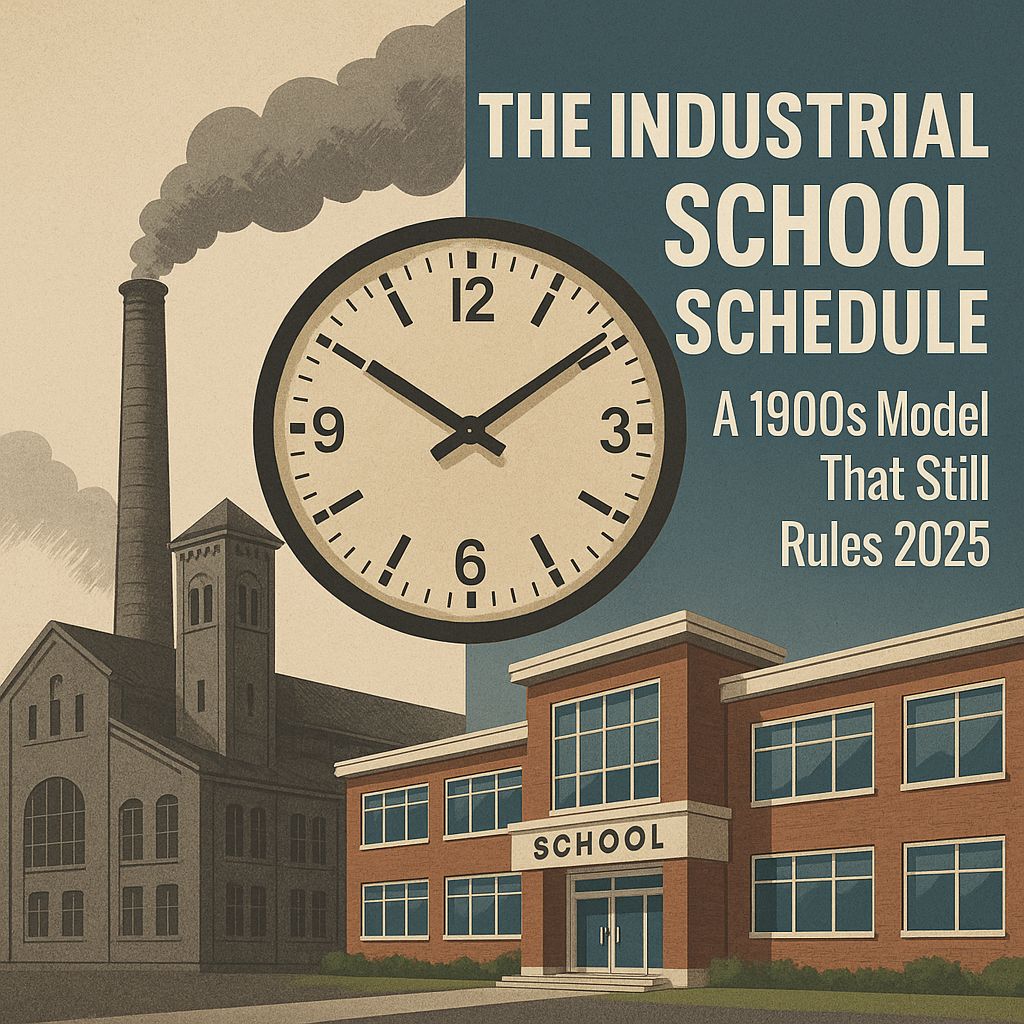
The Industrial School Schedule: A 1900s Model That Still Rules 2025

Lyndsay LaBrier
November 12, 2025
In partnership with

The Systems That Survive: Issue #1
Merchant Ship Collective | Education Catalyst Series
By Lyndsay LaBrier
The Schedule That Refuses to Die
In public education, certain structures continue long after overwhelming evidence proves they do not benefit children. When this happens, the reason is almost always the same: the system benefits someone else.
No example illustrates this more clearly than the American school schedule.
The modern school day—usually an early morning start, rigid class periods, bells signaling transitions, and a mid-afternoon release—is more than 100 years old. It was built during the rise of industrialization to prepare children for factory life. The schedule was never rooted in child development or learning science. It was rooted in efficiency, control, and predictability.
Despite everything we now know about how children learn best, the structure has barely shifted. The reason is simple: entire industries, contracts, and political systems rely on the schedule staying exactly the way it is.
An Industrial Model in a Post-Industrial World
The early 1900s school schedule was designed around the needs of factories, not classrooms. Bells mimicked factory whistles. Students learned to move when told, stay confined to their assigned space, and operate under external control.
Although our world has transformed dramatically—psychology, neuroscience, family structures, and technology have all advanced—the daily structure of school remains largely untouched. This is not because the schedule is effective. It is because changing it would be deeply inconvenient and financially disruptive to the systems built around it.
Why the Schedule Continues Despite the Research
Districts rarely avoid schedule reform because they believe the current model is best for children. Instead, they avoid reform because change threatens existing systems.
1. Transportation Systems Depend on It
Bus routes, driver contracts, and tiered schedules are aligned to the traditional start and end times. Altering these disrupts logistics and significantly increases cost.
2. Labor and Contractual Structures Are Built Around It
Teacher contracts, planning periods, duty assignments, PD days, and calendar structures assume the industrial schedule as the foundation. Changing it would require major renegotiation.
3. Vendors and Service Providers Benefit from Predictability
Testing companies, curriculum publishers, cafeteria vendors, and outside consultants all schedule their services around the existing model. Shifting time disrupts these systems—and their revenue.
4. Political Accountability Relies on Uniformity
State policies measure schools by standardized instructional minutes, predictable testing windows, and rigid reporting cycles. Flexibility threatens the comparison-based accountability system politicians rely on.
5. Community Expectation and Childcare Pressures Reinforce It
The schedule serves as a form of childcare for working families. Districts fear community backlash if changes create complications for adult routines.
These forces have become so entrenched that the question is rarely “What schedule benefits children the most?”
Instead, it becomes “What schedule disrupts adults the least?”
What the Research Actually Shows
Learning science has made one thing undeniably clear: the industrial schedule is misaligned with how children actually learn.
Major findings include:
Adolescents have biological sleep shifts that make early start times harmful to mental health, attention, and academic performance.
Younger children benefit from shorter, more flexible instructional blocks and frequent movement.
Deep learning requires sustained focus, reduced transitions, and protected time for creativity and problem-solving.
Human brains function best when work is balanced with breaks, novelty, and opportunities for meaning.
Yet despite this knowledge, the traditional schedule endures—because the systems surrounding it rely on its stability.
Who Is Harmed When the Schedule Stays the Same?
Children pay the highest price.
They lose sleep, attention, creativity, and mental health.
Teachers lose planning time, autonomy, and professional judgment.
Families lose flexibility and the chance for more human-centered routines.
And schools lose the opportunity to design schedules that support wellness, engagement, and genuine learning.
The fact that we cling to a century-old structure—even when it harms children—is evidence of a deeper truth: our education system prioritizes compliance over growth and convenience over human development.
Historical Pattern: Why Broken Systems Persist
Across history, failing structures tend to survive when they are tied to power, profit, or group identity.
We see this pattern in events like:
the Salem witch trials, where fear kept irrational systems alive
McCarthyism, where institutions defended harmful practices to maintain control
the standardized testing era, where accountability frameworks survived despite documented harm
modern polarization cycles, where institutions cling to old systems because uncertainty feels threatening
Public education is simply repeating the pattern: old systems persist until the cost of change becomes impossible to ignore.
A Child-Centered Schedule: What It Could Look Like
Redesigning the school day is not unrealistic. Districts across the country have implemented more modern, developmentally informed structures with great success. These schedules often include:
later start times for adolescents
flexible blocks for elementary students
fewer transitions and more time for deep focus
integrated movement and brain breaks
community partnerships, project-based learning, and real-world exploration
protected teacher planning
intentional alignment with research on cognitive development
When these models are implemented, engagement rises, behavior improves, mental health stabilizes, and teachers have the time and space they need to teach effectively.
The issue has never been feasibility. It has always been willingness.
Call to Action
To rebuild public education into a system that supports genuine learning, wellness, and human development, we must start by rethinking time itself. If a schedule designed for 1910 is still shaping the lives of children in 2025, then the system is not evolving—it is stagnating.
Communities must begin asking real questions:
Who benefits from the current schedule?
Who is harmed by it?
What would our days look like if we designed them around child development instead of institutional convenience?
What systems, contracts, and structures stand in the way of meaningful change?
We cannot transform education without transforming the framework that governs every minute of a child’s school day.
In solidarity,
Lyndsay LaBrier
Merchant Ship Collective
References
American Academy of Pediatrics. (2014). School start times for adolescents. Pediatrics, 134(3), 642–649.
Tyack, D., & Cuban, L. (1995). Tinkering toward utopia: A century of public school reform. Harvard University Press.
Willingham, D. (2017). The reading mind: A cognitive approach to understanding how the mind reads. Jossey-Bass.
Koch, B. (2020). The industrial origins of the American school schedule. Journal of Educational History, 11(2), 45–60.

The best marketing ideas come from marketers who live it.
That’s what this newsletter delivers.
The Marketing Millennials is a look inside what’s working right now for other marketers. No theory. No fluff. Just real insights and ideas you can actually use—from marketers who’ve been there, done that, and are sharing the playbook.
Every newsletter is written by Daniel Murray, a marketer obsessed with what goes into great marketing. Expect fresh takes, hot topics, and the kind of stuff you’ll want to steal for your next campaign.
Because marketing shouldn’t feel like guesswork. And you shouldn’t have to dig for the good stuff.
Reply